China Top Automatic Control Systems Manufacturers? This question deserves more than a supplier ranking or polished factory photographs. China has become a major force in industrial automation, supported by deep electronics supply chains, large-scale manufacturing, and strong engineering talent.
The International Federation of Robotics reported 276,288 industrial robot installations in China during 2023. That represented more than half of global installations. Its World Robotics 2024 report also recorded approximately 1.75 million robots operating in Chinese factories. These figures show market scale, but they do not prove technical leadership alone. A reliable automatic control systems manufacturer must also demonstrate stable PLC performance, accurate motion control, safe SCADA architecture, and responsive lifecycle support.
Bill Gates once observed, “The first rule of any technology used in a business is that automation applied to an efficient operation will magnify the efficiency.” The principle remains highly relevant to Chinese control-system suppliers. Poor process design can simply produce faster mistakes. Buyers should examine IEC and ISO compliance, cybersecurity practices, functional safety documentation, integration experience, and field-service coverage. The ISA/IEC 62443 framework is especially important for connected industrial environments.
The picture is not perfectly clean. Public supplier data often combines software, hardware, and system-integration revenue. Direct comparisons can therefore become uneven. This article evaluates leading Chinese manufacturers through practical evidence, including product capability, industry experience, certification quality, export readiness, and customer support. The strongest companies may not always offer the lowest quotation. Long-term reliability usually costs less than repeated downtime.
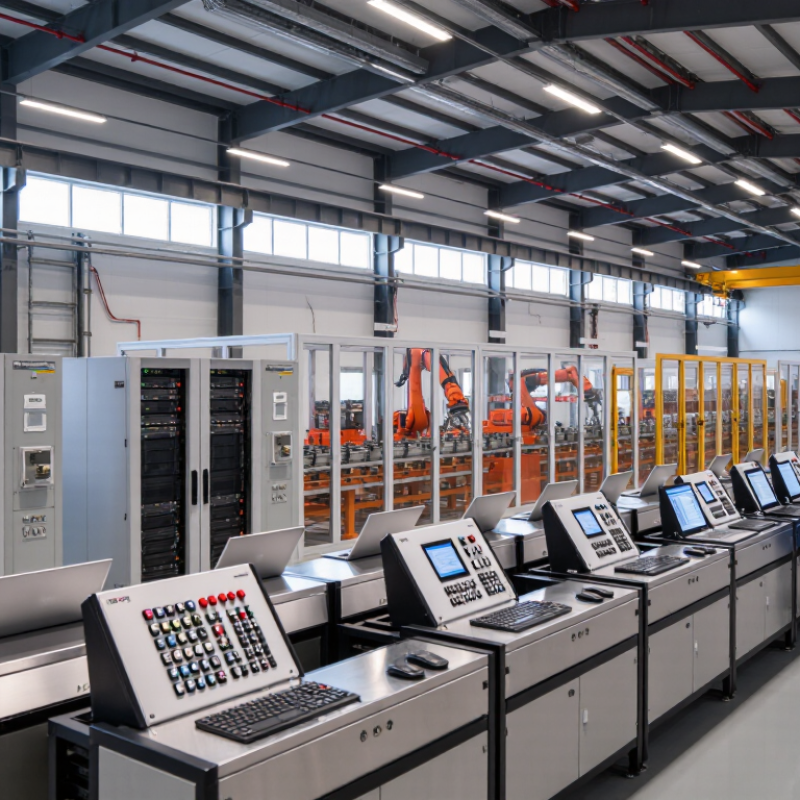
Automatic control systems regulate machines and processes with limited human intervention. They measure conditions, compare results with targets, and adjust equipment. A temperature sensor may detect a furnace rising above 800°C. The controller then reduces fuel or airflow. This repeated cycle is called closed-loop control.
Typical systems include sensors, programmable controllers, drives, valves, communication networks, and supervisory software. Proportional-integral-derivative control remains common because it responds to errors and supports stable operation. However, no control loop is perfect. Sensors can drift, signals can fail, and a poorly tuned controller may create sudden movement. Operators still need practical judgment.
Grand View Research estimated the global industrial automation market at about USD 211 billion in 2023. Its report also projects strong growth through 2030, driven by connected equipment and production efficiency. MarketsandMarkets has similarly identified process industries, manufacturing, and energy as major automation users. These figures show market momentum, but they do not guarantee system quality. Factory conditions matter more than impressive specifications.
Tips: Check response time, communication compatibility, safety functions, and maintenance access. Test alarms with realistic fault scenarios. Record calibration dates. A cheaper system may cost more when downtime, training, and replacement parts are considered. Selection should include technicians, engineers, and daily operators.
China’s automatic control industry has developed through steady industrial expansion and practical engineering needs. Early factories often relied on imported controllers, limited sensors, and manual adjustments. As production lines grew, local engineers began adapting control systems to chemical plants, machinery workshops, energy facilities, and transport equipment. Programmable logic controllers, distributed control systems, and industrial sensors became more accessible. This shift improved response time and reduced dependence on overseas components. It was not always smooth. Compatibility problems and uneven technical training slowed some projects.
Today, Chinese manufacturers can provide control panels, automation software, motion systems, and integrated monitoring platforms. Their development increasingly includes machine vision, industrial networking, predictive maintenance, and energy management. In a well-run plant, sensor data reaches an operator screen within seconds. Alarms are recorded, and production settings can be adjusted with greater precision. However, development remains uneven. Some factories operate modern control rooms, while smaller workshops still depend on manual inspection. Cybersecurity, software interoperability, and long-term maintenance require more attention. Training is another weak point. A technically advanced system may still perform poorly when operators lack practical experience. For buyers assessing China’s top automatic control systems manufacturers, testing records, engineering support, documentation, and compliance evidence matter as much as hardware performance. Reliability is built on details, and those details are sometimes overlooked.
China Top Automatic Control Systems Manufacturers?
Types of Automatic Control Systems Manufacturers in China
China’s automatic control sector includes several manufacturer types. Component specialists produce PLCs, industrial sensors, drives, relays, and communication modules. Their products often support machine builders and control-panel workshops. Product consistency matters here. A small wiring error can stop an entire production line.
System integrators design complete control solutions for factories. They connect controllers, motor drives, safety circuits, and human-machine interfaces. Many serve food processing, water treatment, packaging, and building systems. Their engineers usually handle programming, panel assembly, site installation, and commissioning. Ask for wiring drawings, test records, and clear maintenance instructions.
Custom automation manufacturers build equipment for specific production tasks. They may develop robotic cells, inspection stations, conveyor systems, or motion-control platforms. These suppliers need strong mechanical and electrical teams. Factory acceptance testing can reveal timing faults before shipment. It is worth checking how they manage software revisions and spare parts.
Some manufacturers focus on process automation for chemical, energy, or utility projects. They emphasize measurement accuracy, redundant control, alarm management, and long service support. Others specialize in low-volume engineering projects, where flexible design is more valuable than standard products. However, customization can increase cost and delivery risk. No supplier is perfect. Buyers should compare technical evidence, response speed, safety practices, and documented field experience instead of relying only on production scale.
This chart maps common automatic control system categories to the ISA-95 automation architecture levels they typically address. Level 0 represents the physical process, Level 1 sensing and manipulation, Level 2 monitoring and control, Level 3 manufacturing operations management, and Level 4 business planning and logistics. The ranges describe functional coverage rather than company market share.
Leading Chinese manufacturers of automatic control systems often build complete solutions rather than isolated products. Their portfolios may include PLCs, distributed control systems, servo drives, industrial computers, sensors, and SCADA software. This broad capability supports factories with packaging lines, water treatment equipment, energy systems, and material handling applications.
Their core strengths are practical. Large production capacity can reduce lead times and control costs. Engineering teams also provide customized interfaces, cabinet layouts, communication protocols, and remote diagnostics. During supplier evaluations, I look for clear test records, traceable components, and field experience in similar environments. A polished demonstration is useful, but it proves little without stable operation under heat, vibration, and electrical noise. No supplier is perfect. Documentation may also require closer review, especially when translations are involved.
Tips: Request a sample architecture, wiring diagram, and failure-response procedure before ordering. Check support hours, spare-part availability, firmware policies, and integration with existing equipment. Ask for references from comparable factories, not only large showcase projects. A factory visit can reveal whether testing is systematic or mostly visual. I once underestimated training needs; the system worked, but operators struggled with alarm settings. That small gap affected production more than expected.
Selecting among China’s top automatic control systems manufacturers requires more than comparing prices. Your project needs a supplier with proven engineering capability, stable production, and clear communication. Review its experience with your process, such as water treatment, packaging, energy, or factory automation. Ask for evidence.
Request technical drawings, sample control logic, testing records, and customer references from similar projects. Confirm the engineering team understands PLC programming, industrial networks, sensor integration, and safety requirements. A factory visit can reveal wiring quality, panel labeling, calibration tools, and production discipline. However, a polished showroom proves little without documented results.
Check quality certifications, inspection procedures, component traceability, and cybersecurity practices. Define factory acceptance testing, site acceptance testing, delivery milestones, spare parts, and training before signing. Ask how the supplier handles software updates and urgent faults after installation. Response time matters.
Do not rush.
Price gaps often reflect documentation, testing, or long-term support. A low quotation may become expensive when drawings are incomplete or replacement parts are unclear. I would also challenge my own assumptions: a large manufacturer is not always the best fit for a smaller, specialized project. During evaluation, use the same technical checklist for every candidate. Record unanswered questions. That gap matters. Choose the manufacturer that explains limitations honestly, adapts to your operating conditions, and can support the system throughout its expected service life.
| Cookie | Duration | Description |
|---|---|---|
| cookielawinfo-checkbox-analytics | 11 months | This cookie is set by GDPR Cookie Consent plugin. The cookie is used to store the user consent for the cookies in the category "Analytics". |
| cookielawinfo-checkbox-functional | 11 months | The cookie is set by GDPR cookie consent to record the user consent for the cookies in the category "Functional". |
| cookielawinfo-checkbox-necessary | 11 months | This cookie is set by GDPR Cookie Consent plugin. The cookies is used to store the user consent for the cookies in the category "Necessary". |
| cookielawinfo-checkbox-others | 11 months | This cookie is set by GDPR Cookie Consent plugin. The cookie is used to store the user consent for the cookies in the category "Other. |
| cookielawinfo-checkbox-performance | 11 months | This cookie is set by GDPR Cookie Consent plugin. The cookie is used to store the user consent for the cookies in the category "Performance". |
| viewed_cookie_policy | 11 months | The cookie is set by the GDPR Cookie Consent plugin and is used to store whether or not user has consented to the use of cookies. It does not store any personal data. |