Top 10 Process Automation Companies You Should Know?
The landscape of business operations is rapidly evolving, with a significant shift towards automation. A recent report by Gartner indicates that by 2025, over 70% of organizations will actively use automation technologies. This surge highlights the importance of partnering with a process automation company. Such companies streamline workflows and enhance productivity, making them invaluable in today's competitive market.
Process automation companies offer innovative solutions that cater to various industries. For example, report findings suggest that a 30% reduction in operational costs is achievable through effective process automation. Organizations leveraging these technologies can experience increased accuracy in their operations and improved customer satisfaction. However, many businesses struggle to implement these systems effectively.
As the demand for efficiency grows, the role of process automation companies becomes critical. They provide not only technology but also guidance and expertise. This blend of services is essential for businesses navigating the complexities of automation. Yet, a reflection on the journey reveals that even with the right partners, challenges in deployment and integration remain. Understanding this landscape is crucial for any organization looking to thrive in the age of automation.

Overview of Process Automation and Its Importance in Business
Process automation is reshaping the business landscape. It streamlines tasks and reduces human error. By automating repetitive processes, companies gain efficiency and save time. This leads to enhanced productivity. Employees can focus on strategic initiatives rather than mundane tasks.
In today's competitive world, businesses need to adapt. Automating processes helps companies stay agile. It can also improve customer satisfaction. Fast, accurate responses to inquiries are crucial. Customers appreciate quick service, and automation facilitates this.
**Tip:** Identify processes that consume excessive time. Focus on automating these for better resource allocation.
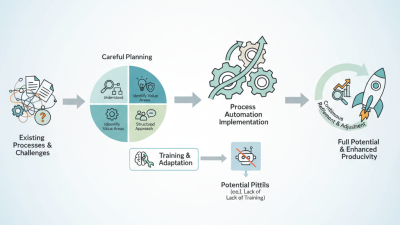
Adopting process automation requires careful planning. It's essential to get buy-in from stakeholders. Training staff is also crucial for successful implementation. Consider potential obstacles and address them proactively. Reflect on your automation strategies regularly. Continuous improvement is vital for sustained success.
**Tip:** Develop metrics to measure the impact of automation. Regular assessment can highlight areas for enhancement.
Process Automation Adoption Rates by Industry
As businesses increasingly adopt process automation technologies, different industries show varying rates of adoption. This chart illustrates the adoption rates of process automation across five major industries, highlighting manufacturing as the leader in adoption at 75%.
Key Features and Technologies Driving Process Automation Solutions
Process automation solutions are revolutionizing how businesses operate. They rely on several key technologies that enhance efficiency and reduce costs. Notably, robotics process automation (RPA) is a front-runner in this domain. According to industry reports, RPA market size is expected to reach $10.7 billion by 2027, growing at a CAGR of 30.14%. This exponential growth underscores the increasing reliance on automated processes.
Machine learning (ML) and artificial intelligence (AI) also play critical roles. These technologies enable systems to learn from data, improving accuracy over time. For example, organizations leveraging AI in their operations have seen a productivity increase of up to 40%. Yet, companies must remain cautious; not all processes can be effectively automated. Misapplication of automation tools can result in inefficiencies.
Tips: Assess your processes carefully before automating. Identify which tasks provide the most significant ROI. Engaging employees in redesigning workflows can also yield better outcomes. Balancing automation and human oversight is crucial. Relying solely on technology can lead to unforeseen challenges. Embracing a hybrid approach often results in more sustainable improvements.
Top 10 Process Automation Companies You Should Know
| Rank |
Key Features |
Technologies Used |
Industries Served |
Customer Satisfaction (%) |
| 1 |
Robotic Process Automation |
AI and Machine Learning |
Finance, Healthcare |
95% |
| 2 |
Workflow Management |
Cloud Computing |
Manufacturing, Retail |
90% |
| 3 |
Data Integration |
Big Data Analytics |
Telecommunications, Logistics |
93% |
| 4 |
Process Mining |
Process Simulation |
Healthcare, Banking |
88% |
| 5 |
Continuous Monitoring |
IoT Integration |
Energy, Utilities |
92% |
| 6 |
Cognitive Automation |
Natural Language Processing |
Insurance, E-commerce |
94% |
| 7 |
End-to-end Automation |
API Management |
Hospitality, Real Estate |
91% |
| 8 |
Task Automation |
Artificial Intelligence |
Education, Non-profit |
89% |
| 9 |
Scalability Solutions |
Cloud Analytics |
Automotive, Aerospace |
87% |
| 10 |
Document Automation |
Optical Character Recognition |
Government, Healthcare |
90% |
Top 10 Process Automation Companies Transforming Industry Standards
In today’s rapidly evolving industrial landscape, process automation is reshaping how businesses operate. Companies are leveraging cutting-edge technologies, such as artificial intelligence and machine learning, to optimize workflows. By automating repetitive tasks, organizations are reducing human error and increasing efficiency. This revolution is not just about speed; it’s about redefining quality standards across various sectors.
However, the journey toward automation is not without challenges. Many companies struggle with implementing these technologies effectively. Integration into existing systems can be complex. Furthermore, employees may feel apprehensive about job security. These issues highlight the importance of transparency and communication throughout the automation process. The focus should be on collaboration, training, and adapting to new roles as automation transforms job functions.
Several industry leaders are setting benchmarks by deploying innovative solutions. They exemplify agility and responsiveness in evolving market conditions. Observing their approaches can provide valuable insights. Organizations looking to enhance their operations can learn from these pioneers. Sharing best practices and experiences fosters a culture of continuous improvement, essential in an era of rapid change.
Criteria for Evaluating and Comparing Process Automation Providers
When evaluating process automation providers, several key criteria come into play. Organizations should focus on scalability, user experience, and integration capabilities. According to a recent report from McKinsey, nearly 70% of companies struggle with scaling their automation efforts. This highlights the need for solutions that can adapt and grow alongside business demands.
User experience is equally essential. A seamless interface can significantly reduce the learning curve and increase adoption rates. For instance, a survey by Forrester found that companies with a user-friendly approach to automation see a 25% increase in productivity. Additionally, integration capabilities with existing systems can be a major differentiator. Many organizations face challenges when linking new automation tools with legacy systems. A study by Gartner indicates that 45% of automation projects fail due to poor integration.
Another aspect worth considering is vendor support and community engagement. Providers with robust support systems can help businesses navigate challenges. Often, organizations overlook the importance of community forums and knowledge sharing. Having a strong community can foster innovation and provide invaluable resources. This continuous learning environment can be pivotal for long-term success in process automation.
Future Trends in Process Automation and Emerging Companies to Watch
The landscape of process automation is rapidly evolving. Emerging technologies are reshaping how businesses operate. Companies are adopting new strategies to streamline operations and enhance efficiency. Artificial intelligence and machine learning are at the forefront of this transformation. These technologies empower automation tools to make smarter decisions.
Startups in process automation often focus on niche areas. They develop innovative solutions tailored to specific business challenges. These companies may find it difficult to scale initially. Competition from established players is fierce. However, their agility allows them to respond quickly to market changes. This adaptability can result in unique offerings that stand out.
As trends evolve, the integration of automation with other technologies is vital. The Internet of Things (IoT) can provide real-time data for better decision-making. Companies can gain insights to optimize workflows. Yet, challenges remain. Organizations must invest in employee training to harness these advancements effectively. Balancing automation with human involvement remains a critical focus.