
Global buyers are entering 2026 with more Steerable Transfer Cart choices than ever. Battery-powered, hydraulic-steering, omnidirectional, and heavy-duty custom models now serve different factory conditions. Each type promises easier movement. Not every promise deserves a premium.
Lars Meier, a heavy-load transport consultant, explains the core issue: “A cart is only useful when its steering, floor fit, and service plan work together.” His observation reflects real purchasing experience. A 60-ton cart may perform well on a smooth concrete floor. It may struggle on uneven expansion joints. A compact electric model may suit steel coils, molds, or machinery. It may lack endurance during continuous shifts.
This guide examines the leading 2026 Steerable Transfer Cart types for international buyers. It considers rated capacity, platform dimensions, turning radius, battery chemistry, control systems, safety features, and maintenance access. It also reviews export realities, including voltage compatibility, spare-part availability, documentation, and operator training. Small details matter. A remote controller with poor visibility can slow production. A narrow wheelbase can create stability concerns during sharp turns. Buyers should compare test reports, load simulations, warranty terms, and factory experience before choosing. Specifications can look impressive. Practical fit is harder to measure. That is where many purchasing decisions become uncertain. A reliable cart should match the real route, not only the catalogue image.
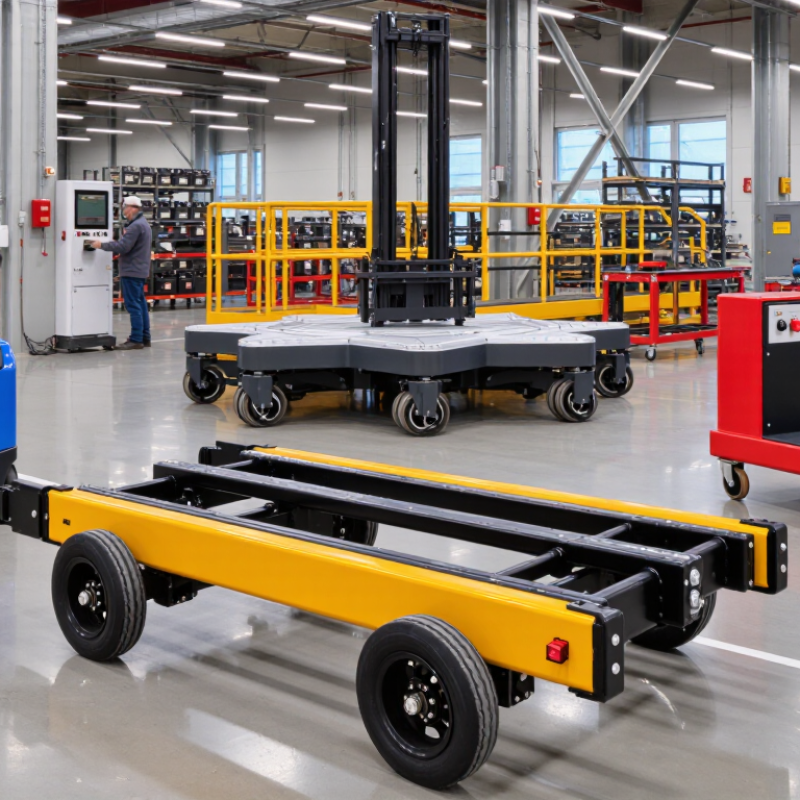
A steerable transfer cart is a powered platform for moving heavy loads across factory floors, yards, or assembly areas. Unlike fixed rail carts, its wheels can change direction during travel. This flexibility suits changing routes, temporary work zones, and large workshops. Common versions include battery-powered, rail-guided, and trackless carts. The best choice depends on load mass, floor quality, turning space, and duty cycle.
Most models use electric drive motors connected to wheel assemblies. A controller receives commands from a pendant, wireless handset, or onboard system. Steering actuators then turn the wheels to follow a selected path.
Sensors may monitor speed, position, obstacles, and battery condition. When the operator commands a stop, braking systems reduce movement before the cart becomes stationary. The cart should move slowly near workers.
Sound simple? Not always. Load distribution, wheel traction, and uneven flooring can change handling. Engineers usually verify these factors through calculations and practical trials.
From field experience, operators value predictable steering more than impressive top speed. A cart that turns sharply but stops poorly creates avoidable risk.
Maintenance teams inspect tires, steering joints, brakes, batteries, controls, and emergency devices. They also record stopping distances under real load conditions.
Trackless carts offer flexibility, but painted routes can fade and confuse operators. That weakness deserves attention during purchasing. No design is perfect.
Which Steerable Transfer Cart Types Are Leading in 2026?
In 2026, battery-powered rubber-tired steerable transfer carts are gaining strong interest among global buyers. They move across factory floors without fixed rails, which helps plants change layouts quickly. Their electric drive reduces exhaust, noise, and indoor maintenance concerns. Many models use multi-wheel steering, allowing tighter turns around columns, presses, and storage racks. This flexibility is valuable in shipyards, steel plants, machinery workshops, and large assembly halls.
Rail-guided steerable carts remain important for repeated routes and heavy loads. They offer stable tracking, controlled positioning, and predictable travel cycles. Some newer designs combine rail guidance with steerable wheel assemblies. This approach supports accurate movement while reducing alignment problems during loading. Battery-electric systems with automatic charging are also leading when carts operate through long shifts. However, charging speed, battery temperature, and floor conditions still require careful evaluation.
Modular multi-axle carts are another practical choice for oversized equipment. Their platform can distribute weight across many wheels and reduce floor pressure. They are useful for transformers, structural sections, and industrial molds. Yet, more wheels can mean more inspection points and higher maintenance demands. Buyers should check turning radius, rated load, emergency stopping distance, and operator visibility before choosing a type. The market is moving quickly, but the most advanced cart is not always the best fit. A simpler design may perform better in a dusty workshop with uneven flooring.
| Steerable Transfer Cart Type | Typical Steering Method | Typical Load Capacity | Typical Travel Speed | Power Configuration | Turning Capability | Best-Fit Applications | 2026 Buyer Position |
|---|---|---|---|---|---|---|---|
| Battery-Powered Trackless Transfer Cart | Electric steering axle with onboard controller | 10–500 tonnes | 0–25 m/min, depending on load and floor conditions | Rechargeable battery; lithium-ion or lead-acid options | Steerable travel with forward, reverse, and curved movement | Heavy manufacturing, steel handling, shipyards, and assembly halls | Leading general-purpose choice because it requires no embedded rail and supports flexible plant layouts |
| Omnidirectional Transfer Cart | Independent wheel modules or Mecanum-style wheel arrangement | 5–100 tonnes | 0–20 m/min | Battery-electric drive with electronic motion control | Forward, lateral, diagonal, and in-place rotation | Tight production cells, tooling areas, aircraft assembly, and constrained workshops | High-growth option where floor-space utilization and precise positioning are priorities |
| Rail-Guided Steerable Transfer Cart | Flanged wheels or guided wheels running on fixed rails | 20–1,000 tonnes | 0–30 m/min | Battery, cable reel, busbar, or low-voltage rail power | Controlled route; steering is limited by the rail layout | Steel plants, foundries, warehouses, and repetitive point-to-point transport | Preferred for very high loads, repeatable routes, and maximum positional stability |
| AGV-Integrated Steerable Transfer Cart | Software-controlled steering with magnetic, QR, lidar, or natural-feature navigation | 1–100 tonnes | 0–60 m/min, subject to safety and site configuration | Battery-electric with automatic charging or opportunity charging | Programmable routes, controlled curves, and automatic docking | Automotive, intralogistics, warehouses, and digitally managed factories | Strategic choice for buyers seeking traceability, fleet management, and reduced manual handling |
| Hydraulic-Steering Heavy-Duty Transfer Cart | Hydraulic steering cylinders with mechanically linked wheel assemblies | 50–1,000+ tonnes | 0–15 m/min | Battery-electric or diesel-hydraulic power package | Large-radius steering designed for controlled heavy-load movement | Shipbuilding, modular construction, power equipment, and oversized fabrication | Strong specialist solution for extreme loads and demanding outdoor or uneven-site conditions |
| Cable-Reel-Powered Steerable Cart | Electric steering system with guided or manually defined travel paths | 20–500 tonnes | 0–25 m/min | Trailing cable reel connected to a fixed industrial power supply | Steering depends on cable management and route geometry | Long shifts, high-duty-cycle production, and areas with reliable fixed power access | Cost-effective for continuous operation where battery charging downtime is unacceptable |
| Low-Profile Die Transfer Cart | Electromechanical steering axle or compact omnidirectional wheel system | 5–80 tonnes | 0–15 m/min | Battery-electric, commonly with automatic or manual charging | Small turning radius for movement beneath presses and tooling stations | Stamping, injection molding, die maintenance, and machine-tool loading | Practical niche leader where low deck height, accurate alignment, and compact dimensions are essential |
Steerable transfer carts differ mainly in how they turn, carry loads, and receive power. Rail-guided carts use fixed steel wheels and follow a defined route. They suit repetitive movement between two points. Trackless carts use rubber wheels, electric steering, and programmable controls. They can approach a workstation from different angles. Four-wheel steering reduces turning radius, while differential steering simplifies the chassis but may increase tire wear. A small turning circle matters in crowded workshops.
Power selection changes operating risk and maintenance. The International Energy Agency reported that global battery demand for electric vehicles exceeded 750 GWh in 2023, rising about 40% year over year. This growth supports wider battery availability, but industrial carts still need larger safety margins, thermal monitoring, and charging discipline. Battery power is not automatically the best choice.
Cable-reel systems support long duty cycles without frequent charging. However, cables can obstruct walkways and require careful routing. Conductor-rail systems provide continuous power for fixed paths, but installation demands precise alignment and electrical protection. Diesel or hybrid systems may suit outdoor yards, yet emissions, noise, and fuel handling require stricter site controls. ISO 3691-4:2020 emphasizes risk assessment for driverless industrial trucks, including speed, visibility, and protective functions. In practice, many buyers overvalue maximum capacity. Turning space, floor condition, charging access, and emergency stopping deserve equal attention. Some designs look efficient on paper, but perform poorly around uneven floors.
In 2026, steerable transfer carts serve factories that need flexible movement without permanent tracks. Manual steerable carts suit maintenance areas, tool rooms, and light fabrication lines. They handle pallets, dies, and machine parts at moderate weights. Operators need clear visibility and firm flooring. They also need training.
Battery-powered steerable carts fit steel plants, shipyards, foundries, and heavy equipment workshops. They can move coils, molds, frames, and assemblies across changing routes. A low deck helps workers load large items with cranes or forklifts. Check battery range carefully. A cart that stops during a shift creates an expensive delay.
Rail-guided carts remain practical for repeated routes between furnaces, warehouses, and production bays. They suit heavy loads and predictable travel, but rails reduce layout flexibility. Multi-directional carts work better in tight plants with narrow aisles and frequent turns. They can reposition long beams or fabricated structures beside workstations. Load balance matters more than many buyers expect. An uneven mold may shift during steering, even when its total weight stays below the rated capacity. No selection is perfect. Floor joints, turning space, humidity, and charging access can change the result. A site trial with the actual load often reveals problems that a specification sheet misses.
2026 Top Steerable Transfer Cart Types for Global Buyers
Global buyers can compare rail-guided, battery-powered, and omnidirectional transfer carts. Each type suits different plant layouts. Rail-guided carts offer predictable movement and simpler route control. Battery models reduce installation work but require charging discipline. Omnidirectional carts provide tighter maneuvering around columns and workstations. Safety should come first. The International Labour Organization estimated nearly three million work-related deaths annually worldwide. This figure is not cart-specific, but it shows why guarding, emergency stops, load sensors, and tested braking systems deserve serious attention.
Cost comparison needs more than the purchase price. Check batteries, rails, floor preparation, operator training, spare parts, and planned downtime. The International Federation of Robotics reported 541,302 industrial robots installed globally in 2023. Growing automation increases the value of dependable material movement, but it also raises integration expectations. A cheaper cart may fail that test. Buyers should request load-test records, risk-assessment documents, component availability, and realistic service-response times. Support quality varies widely. That is easy to underestimate.
Tips: Ask for a five-year ownership estimate. Compare energy use per shift. Test turning clearance with the real load. Confirm local technician coverage. Review software updates and warranty exclusions. Do not accept vague safety claims. One uncomfortable question helps: who responds when production stops at 2 a.m.? Data sheets rarely answer it. Also, some projected savings will be wrong because traffic patterns change after installation. Keep contingency budget and measure actual performance during the first ninety days.
How can global buyers compare safety, cost, and support? This qualitative benchmark uses a 1–5 scale based on typical equipment characteristics: 5 indicates stronger performance or better buyer value. Cost efficiency considers total ownership value rather than purchase price alone.
Rail-guided carts generally provide predictable routing and high payload stability. Trackless battery carts offer flexible layout changes, while AGV-style carts provide stronger automation potential but usually require more infrastructure and integration support. Actual results vary with payload, duty cycle, site conditions, safety systems, and local service availability.
| Cookie | Duration | Description |
|---|---|---|
| cookielawinfo-checkbox-analytics | 11 months | This cookie is set by GDPR Cookie Consent plugin. The cookie is used to store the user consent for the cookies in the category "Analytics". |
| cookielawinfo-checkbox-functional | 11 months | The cookie is set by GDPR cookie consent to record the user consent for the cookies in the category "Functional". |
| cookielawinfo-checkbox-necessary | 11 months | This cookie is set by GDPR Cookie Consent plugin. The cookies is used to store the user consent for the cookies in the category "Necessary". |
| cookielawinfo-checkbox-others | 11 months | This cookie is set by GDPR Cookie Consent plugin. The cookie is used to store the user consent for the cookies in the category "Other. |
| cookielawinfo-checkbox-performance | 11 months | This cookie is set by GDPR Cookie Consent plugin. The cookie is used to store the user consent for the cookies in the category "Performance". |
| viewed_cookie_policy | 11 months | The cookie is set by the GDPR Cookie Consent plugin and is used to store whether or not user has consented to the use of cookies. It does not store any personal data. |