
Selecting a Burr Oak Fin Press for global sourcing requires more than comparing catalog prices. The right machine must match your fin material, tube dimensions, production volume, and factory skills.
W. Edwards Deming, a respected manufacturing-quality authority, said, “Quality comes not from inspection, but from the improvement of the production process.” That principle matters when evaluating a Burr Oak Fin Press. Buyers should examine forming accuracy, repeatability, tool-change time, and maintenance access before negotiating terms. A press may look efficient on paper, yet perform poorly with thin aluminum strip or demanding fin geometries.
Look closely.
Request sample parts made from your actual material. Measure fin height, pitch consistency, burr formation, and tube fit under controlled conditions. Ask the supplier for cycle-time data, electrical requirements, spare-parts lists, and operator-training plans. A clear factory acceptance test can expose problems before shipment.
Global sourcing adds practical risks. Freight dimensions, installation support, language differences, and regional service coverage can affect the total investment. Confirm voltage standards and documentation early. Also verify whether replacement tooling can arrive within your production schedule.
The cheapest quotation may not be the lowest-cost choice. Downtime, unstable forming, and unavailable tooling quickly change the calculation. I would still question every optimistic delivery promise. Real production rarely behaves as smoothly as a sales presentation suggests.
A reliable decision combines technical trials, supplier references, lifecycle costing, and documented quality controls. This approach does not remove uncertainty. It makes uncertainty visible, measurable, and easier to manage.
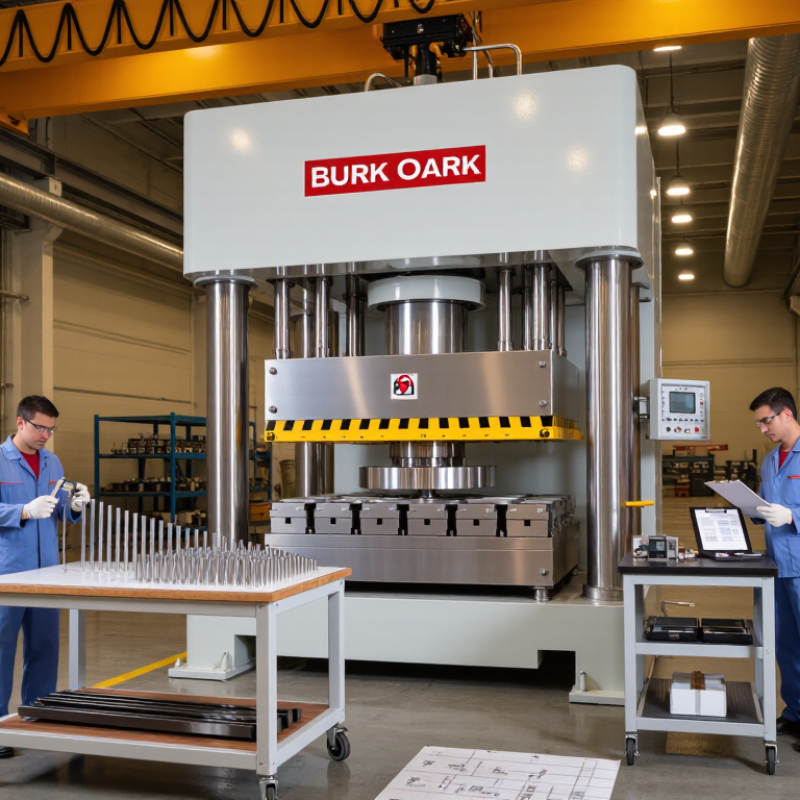
A Burr Oak fin press should be defined by its working range, not its catalog name. For global sourcing, confirm compatibility with 0.08–0.50 mm strip thickness and the required fin pitch. Thin strip demands stable feeding, accurate leveling, and controlled stamping force. A practical trial should measure burr height, louver angle, pitch variation, and coil alignment after continuous production.
Fin pitch directly affects airflow, heat transfer, and clogging risk. Smaller pitches can increase surface area, but they may raise pressure drop and require cleaner tooling. The IEA’s Future of Cooling report projects global space-cooling electricity demand could exceed 6,200 TWh by 2050, compared with about 2,020 TWh in 2016. This growth increases pressure for efficient, repeatable heat-exchanger production. However, the report does not define one universal pitch. Design conditions still matter.
Ask suppliers for inspection records at both thickness limits. Request samples using your actual aluminum grade, temper, coating, and target pitch. Check whether the press maintains pitch within the drawing tolerance during speed changes. A useful acceptance test includes at least three coil runs, dimensional checks every 500 meters, and a final fin-stack inspection. I would not trust a single sample. It can hide feeding instability. Also compare die maintenance intervals, spare-part lead times, noise data, and operator access. These details often decide total sourcing cost more than the initial press price.
| Strip Thickness | Typical Fin Pitch | Typical Fin Height | Suitable Fin Materials | Recommended Press Configuration | Key Sourcing Consideration |
|---|---|---|---|---|---|
| 0.08–0.12 mm | 1.5–3.0 mm | 3–12 mm | Aluminium foil; thin copper strip | High-speed roll forming with low-inertia tooling and precise strip tension control | Check minimum strip tension, burr control, guide alignment and protection against material buckling |
| 0.13–0.20 mm | 2.0–4.0 mm | 5–20 mm | Aluminium; copper; coated aluminium | Servo-fed fin press or roll-forming press with interchangeable fin-pitch tooling | Prioritize repeatable pitch, stable feed length and quick tooling changeover |
| 0.21–0.30 mm | 2.5–5.0 mm | 8–30 mm | Aluminium; copper; stainless steel | Rigid mechanical or servo press with adjustable guides and positive strip feeding | Verify forming force, die clearance, feed accuracy and compatibility with harder tempers |
| 0.31–0.40 mm | 3.0–6.0 mm | 10–35 mm | Aluminium; copper; stainless steel | Heavy-duty fin press with robust frame, higher forming capacity and reinforced tooling | Request load curves, maximum coil width, press rigidity data and tool-life expectations |
| 0.41–0.50 mm | 4.0–8.0 mm | 12–40 mm | Aluminium; copper; stainless steel | High-capacity mechanical or servo press with reinforced die set and controlled lubrication | Confirm available press tonnage, maximum material strength, die opening and maintenance access |
When selecting a burr oak fin press, begin with the material, not the machine price. Aluminum offers about 205 W/m·K thermal conductivity, while copper reaches approximately 385 W/m·K. These values are useful benchmarks, but alloy, temper, and surface condition can change actual performance. Confirm the material certificate before comparing supplier quotations.
Aluminum usually forms more easily and requires less pressing force. It also reduces part weight and may simplify shipping.
Copper transfers heat faster, but its higher density can demand stronger tooling and tighter process control.
A fin press for copper should handle greater forming resistance without damaging thin fin edges. Check stroke stability, die alignment, feed accuracy, and burr control during sampling.
I once compared presses using conductivity alone. That was a poor shortcut. The copper sample performed well thermally, yet its fins showed slight distortion after repeated runs.
The aluminum sample was less conductive but held its geometry better. Measure fin height, pitch, flatness, and thermal resistance after production, not only after one trial.
Ask for process records, inspection data, and repeat samples from different batches. Small details matter.
Selecting a fin press for global sourcing requires more than comparing tonnage and price. Capacity must match strip width, material thickness, and forming depth. A press rated at 80 tons may perform poorly when production demands deep, narrow fins. MarketsandMarkets reported that the global heat exchanger market could reach about USD 27.5 billion by 2028, increasing pressure on suppliers to deliver consistent output. Capacity planning matters.
Line speed should be verified under real forming conditions, not empty-machine demonstrations. Ask for tested strokes per minute using your aluminum or copper coil. Record scrap rates, feeder accuracy, die changes, and restart time. For a ±0.05 mm fin-height tolerance, inspect parts across the full coil width and during long production runs. A laser micrometer can capture height variation continuously, while a calibrated gauge confirms sample results. ISO 9001 supports controlled measurement systems, but certification alone does not prove press capability. I have seen impressive trial samples fail after thermal expansion and tool wear appeared.
Tips: Request a capability study with at least 30 consecutive parts. Check Cpk, not only average height. Review maintenance records and spare-part lead times for each sourcing region. Leave room for adjustment; my first tolerance estimate was too optimistic when material hardness changed between lots. Also confirm electrical standards, operator training, guarding, and acceptance criteria before signing the purchase contract.
Evaluate press capacity, line speed, and the required ±0.05 mm fin-height tolerance before comparing suppliers.
The benchmark compares three anonymous press configurations commonly used for fin-forming production. Higher capacity and line speed improve output, while the fin-height tolerance indicates dimensional control. For applications requiring ±0.05 mm, confirm capability with trial-run measurements, process capability data, and inspection records rather than relying only on rated speed.
A reliable fin press starts with tooling that matches the heat exchanger design. Check die life, changeover time, fin pitch, and material thickness. Hardened tooling may cost more initially. It can reduce burrs, rework, and unplanned maintenance. Ask for measured results, not only catalogue claims. A practical trial should run several coil lengths and record scrap rates.
Automation affects more than labor. Automatic strip feeding, tension control, and fault detection can stabilize fin quality across different shifts. However, complex automation needs trained technicians and accessible spare parts. In one sourcing review, our first staffing estimate was too optimistic. The press required more setup attention during the first month. That changed the expected payback period.
Energy use deserves a machine-level comparison. Record motor power, idle consumption, compressed-air demand, and heating requirements. A lower rated motor does not always mean lower operating cost. Production speed and rejection rates matter more. Calculate total cost per heat exchanger using tooling, labor, electricity, maintenance, scrap, freight, and downtime. Use real production data when possible. Small errors become expensive at global volumes. Leave room for currency changes and local service costs. A spreadsheet helps, but it cannot replace a factory trial. Measure one complete production cycle.
When choosing a burr oak fin press for global sourcing, verify the supplier beyond photographs and price. Request a current ISO 9001 certificate, then check its certificate number, validity, and certified production scope. The scope should cover manufacturing or quality control for relevant machinery. A certificate limited to office administration is not enough. Ask for inspection records, material specifications, and a sample acceptance report. These documents reveal how consistently the press is built.
CE compliance also needs careful review. Request the EU Declaration of Conformity and identify the directives and standards applied to the exact model. Check whether the machine includes guarded moving parts, emergency stops, clear labels, and reliable electrical documentation. CE marking alone does not prove superior performance. It confirms declared conformity with applicable requirements. I have seen attractive files with missing model numbers. That gap deserves questions.
Tips:
Confirm the spare-parts list before ordering. Ask about commonly replaced bearings, seals, cutting or pressing components, electrical parts, and delivery times. Service coverage matters too. Request remote troubleshooting, installation guidance, manuals, and technician response times. A supplier with regional support can reduce downtime, but coverage should be written into the agreement. Test communication with a technical question before payment. Slow replies may become slower after delivery. I would also request a video of the press operating with comparable burr oak material. It may not represent your exact conditions, but it exposes noise, alignment, and workflow issues. My checks are never perfect, so independent inspection remains worthwhile.
| Cookie | Duration | Description |
|---|---|---|
| cookielawinfo-checkbox-analytics | 11 months | This cookie is set by GDPR Cookie Consent plugin. The cookie is used to store the user consent for the cookies in the category "Analytics". |
| cookielawinfo-checkbox-functional | 11 months | The cookie is set by GDPR cookie consent to record the user consent for the cookies in the category "Functional". |
| cookielawinfo-checkbox-necessary | 11 months | This cookie is set by GDPR Cookie Consent plugin. The cookies is used to store the user consent for the cookies in the category "Necessary". |
| cookielawinfo-checkbox-others | 11 months | This cookie is set by GDPR Cookie Consent plugin. The cookie is used to store the user consent for the cookies in the category "Other. |
| cookielawinfo-checkbox-performance | 11 months | This cookie is set by GDPR Cookie Consent plugin. The cookie is used to store the user consent for the cookies in the category "Performance". |
| viewed_cookie_policy | 11 months | The cookie is set by the GDPR Cookie Consent plugin and is used to store whether or not user has consented to the use of cookies. It does not store any personal data. |