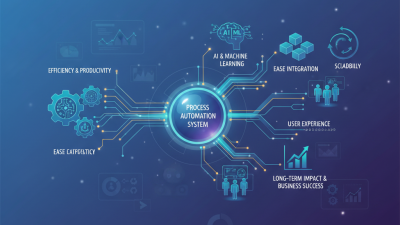
In today's fast-paced business environment, automation solutions are becoming essential for companies striving for efficiency. According to a recent report by McKinsey, organizations that adopt automation can boost productivity by up to 30%. This significant increase highlights the urgency for businesses to explore innovative automation strategies. However, implementing these solutions is not without challenges.
Understanding which automation solutions to implement can be daunting. Companies often struggle with integrating these technologies into existing processes. A study by Deloitte found that 65% of firms face difficulties in scaling their automation efforts. Despite these hurdles, the potential rewards are substantial. The right automation solutions can streamline operations and reduce costs.
Adopting automation solutions requires careful planning and constant evaluation. As companies embrace this shift, they must remain vigilant about potential pitfalls, such as over-reliance on technology. Balancing human insight with automated processes is crucial for sustainable growth. In this evolving landscape, it's imperative to stay informed and adapt strategies to truly harness the power of automation.

Automation is reshaping the way businesses operate. One key trend is the rise of artificial intelligence in workflow optimization. AI can analyze vast amounts of data quickly. This capability allows for more informed decision-making. However, relying too much on AI can lead to oversight. Human intuition is still essential in many scenarios.
Another important trend is the integration of automation tools across various departments. When marketing, sales, and operations work together, efficiency increases. Automated reporting helps keep everyone informed. Yet, integrating these systems can be challenging. Teams may resist changes to their traditional workflows. It’s vital to address these concerns openly.
The adoption of cloud-based automation solutions also stands out. These platforms offer flexibility and scalability. Businesses can adjust resources as needed. But, security issues often arise. Protecting sensitive data in the cloud is crucial. Companies must ensure they are compliant with best practices.
| Solution Name | Key Features | Business Impact | Industry Applications |
|---|---|---|---|
| Robotic Process Automation (RPA) | Automates repetitive tasks, integrates with existing systems | Reduces costs by 30%, increases processing speed | Financial Services, Healthcare |
| AI-Powered Chatbots | 24/7 customer support, self-service capabilities | Increases customer satisfaction, reduces support costs by 25% | Retail, E-commerce |
| Marketing Automation Platforms | Email campaigns, lead scoring, analytics | Improves ROI by 20%, enhances targeting precision | Marketing, Advertising |
| Supply Chain Automation | Inventory management, order processing | Reduces lead times, minimizes inventory costs | Manufacturing, Logistics |
| Document Automation Tools | Document creation, e-signatures | Saves time, improves compliance | Legal, HR |
| DevOps Automation | Continuous Integration/Continuous Deployment (CI/CD) | Accelerates software delivery, reduces time to market | Software Development, IT |
| HR Automation Systems | Employee onboarding, payroll processing | Streamlines HR processes, improves employee experience | Human Resources |
| Facilities Management Automation | Maintenance scheduling, energy management | Reduces maintenance costs, enhances building efficiency | Real Estate, Facility Management |
| Financial Automation Software | Invoicing, expense management | Increases accuracy, reduces financial close time | Finance, Accounting |
| Customer Relationship Management (CRM) Automation | Lead management, sales tracking | Improves sales processes, enhances customer engagement | Sales, Customer Service |
In today's fast-paced business environment,
artificial intelligence (AI)
is reshaping automation strategies. Companies increasingly rely on AI to streamline operations and enhance productivity.
These systems analyze vast data sets rapidly, identifying trends that humans might miss.
Automation boosts efficiency, but it also introduces challenges.
Teams face new roles that can be overwhelming.
AI-powered tools can
automate repetitive tasks, freeing employees for more complex work.
For instance, chatbots handle customer inquiries around the clock, improving response times.
However, this reliance on technology poses risks.
Errors in AI algorithms can lead to misguided decisions.
It is crucial for businesses to monitor these systems actively.
Additionally, integrating AI into existing workflows requires careful planning.
Teams must adapt to new technological changes, which may cause resistance.
Training is essential for staff to understand and leverage these tools effectively.
A well-executed strategy allows businesses to harness the benefits of automation while addressing its shortcomings.
In the fast-paced world of business, efficiency is vital. Companies are increasingly leveraging software tools to streamline processes. Automation solutions have transformed the way businesses operate. From managing tasks to analyzing data, these tools add significant value. They help in reducing errors and saving time.
Consider a project management tool. It simplifies task assignment and progress tracking. Teams can collaborate in real-time, making communication seamless. However, not all tools are perfect. Many businesses struggle with the learning curve. Employees may resist changes, leading to frustration. Successful implementation requires proper training and support.
Data analytics tools are also crucial. They help in making informed decisions based on real-time data. Insights can drive productivity and profitability. Yet, organizations need to ensure data security. Protecting sensitive information is paramount. Balancing efficiency with safety is a challenge. In the race for automation, businesses must reflect on their unique needs. Choosing the right tools is never straightforward. Each solution has its strengths and weaknesses.
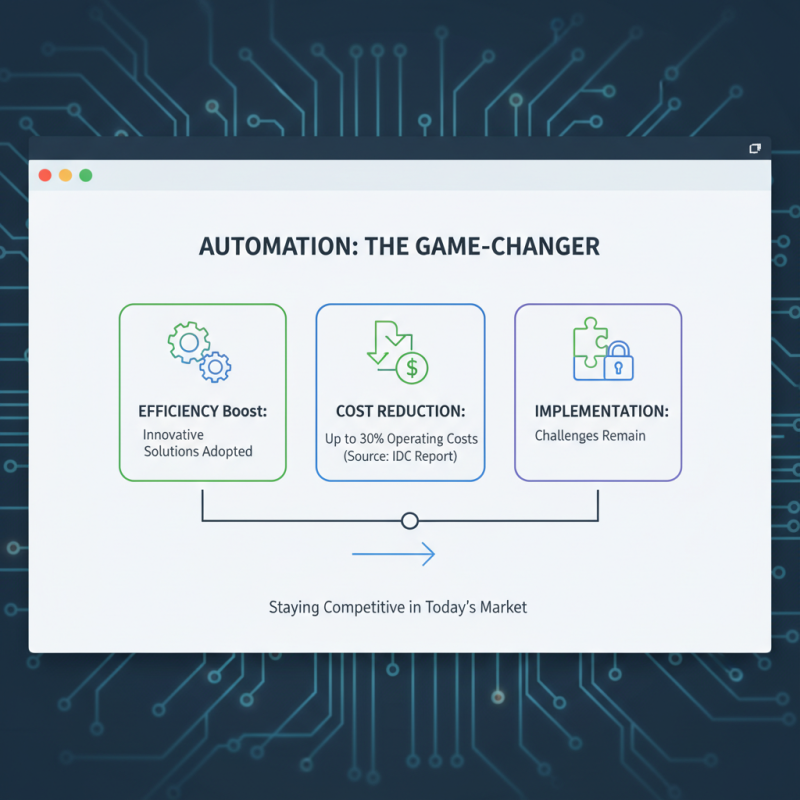
Automation has become a game changer across various industries. Many companies have adopted innovative solutions to boost efficiency. A report from IDC reveals that automation strategies can reduce operating costs by up to 30%. These savings are crucial for staying competitive in today’s market. However, implementation is not without challenges.
For example, in manufacturing, a recent case study highlighted that a company automated its inventory management. This led to a 25% decrease in stock discrepancies. Yet, they initially faced difficulties integrating new software with existing systems. Similarly, in retail, automation of order processing improved accuracy by 40%. But it required significant training for employees to adapt.
In the healthcare sector, automation streamlined patient scheduling. A notable success saw appointment rates increase by 15%. Yet, the transition was not seamless. Some patients expressed concerns over impersonal experiences. These examples illustrate both the benefits of automation and the need for a thoughtful approach. Balancing efficiency with human touch remains a pressing issue.
The future of automation is rapidly evolving. Reports indicate that by 2025, the global automation market could reach $214 billion. Innovations are crucial for staying competitive. Advanced technologies like artificial intelligence (AI) and machine learning (ML) reshape how businesses operate. They promise reduced operational costs and increased productivity.
One notable trend is hyperautomation. This approach combines multiple automation tools to streamline processes. A recent study highlighted that 65% of companies implementing hyperautomation reported significant efficiency gains. However, the integration of these technologies often presents challenges. Workers might face skill gaps, and adapting to new systems can be daunting.
Another area worth exploring is robotic process automation (RPA). This technology focuses on automating repetitive tasks. By 2024, the RPA market is expected to grow by over 30%. Yet, businesses must tread carefully. Over-reliance on RPA can lead to misaligned objectives and operational bottlenecks. Transitioning to this automated landscape requires careful planning and continuous evaluation. Balancing innovation with human oversight is essential for sustainable growth.
| Cookie | Duration | Description |
|---|---|---|
| cookielawinfo-checkbox-analytics | 11 months | This cookie is set by GDPR Cookie Consent plugin. The cookie is used to store the user consent for the cookies in the category "Analytics". |
| cookielawinfo-checkbox-functional | 11 months | The cookie is set by GDPR cookie consent to record the user consent for the cookies in the category "Functional". |
| cookielawinfo-checkbox-necessary | 11 months | This cookie is set by GDPR Cookie Consent plugin. The cookies is used to store the user consent for the cookies in the category "Necessary". |
| cookielawinfo-checkbox-others | 11 months | This cookie is set by GDPR Cookie Consent plugin. The cookie is used to store the user consent for the cookies in the category "Other. |
| cookielawinfo-checkbox-performance | 11 months | This cookie is set by GDPR Cookie Consent plugin. The cookie is used to store the user consent for the cookies in the category "Performance". |
| viewed_cookie_policy | 11 months | The cookie is set by the GDPR Cookie Consent plugin and is used to store whether or not user has consented to the use of cookies. It does not store any personal data. |